The Human Algorithm: scribbles from the plane back from Hamburg
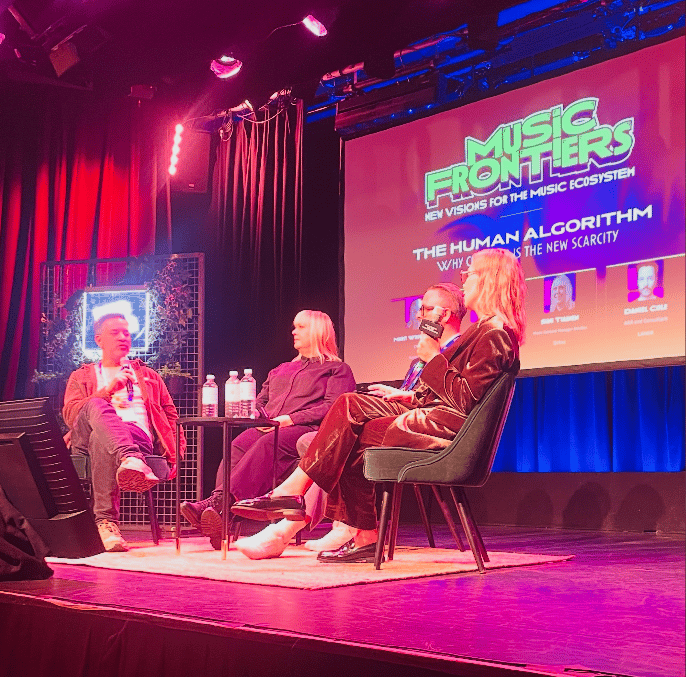
A few days ago I was in Hamburg for Music Frontiers, part of the Reeperbahn Festival, speaking on a panel called The Human Algorithm. We talked about where music discovery is heading, how recommendation systems are affecting the way we listen, and where human curation still fits in. Good conversation, good people: Marit Woody-Lambin (Svensk Jazz) chairing, Sini Curation Manager at Qobuz and Daniel Cole, music journalist, curator from Berliner, LANDR and more.
I scribbled down a few thoughts and questions on the plane back. These are the ones that maybe make sense to share – let’s see what I think of them in a year.
I’ll treat this more like a collage of extracts and thoughts, rather than a long cohesive read. Let’s see how that works.
“Why do we still need humans for curation?
Why can’t machines just do it and everyone be content?”
If a machine knows what I like and what I skipped, and it’s built to please, why would I need a human curator?
It depends what you’re optimising for. If you want the next obvious track for a casual listener, the machine wins. It can index huge catalogues, pull averages from millions of users and serve the result instantly. No human can compete with that.
The problem is mainstream streaming algorithms are tuned for engagement, not user excitement. Keeping you on the service is different from handing you something that makes you excited. And I doubt they track or care about how many users are getting alienated by the recommendations – they’re just lost in the mainstream ocean of users.
Let’s see what the curator really does: they’ve spent years absorbing culture, digging deeper, maybe being a bit difficult and connecting dots not everybody sees. They’re not just guessing what goes next. They’re taking a risk recommending or playing music you have probably never heard of but that’s worth your time.
So if you’re a user just wanting to listen to something the way you would listen to the radio in previous decades, machine curation is fine. If you want to really go deeper and have some quality discoveries, you need guidance, context, a nice experience, perhaps human connection.
Homogenisation vs excitement:
“Should a recommendation system try to predict what I will like, or deliberately expose me to things I may not like yet?”
Most recommendation systems start with what you fed them. But few people bother really doing the work or tuning the system. (True story: I have actually tried to meticulously feed it top notch music and I still got slop!)
It’s not rocket science to say you like Nas and get a few hundred golden era hip hop tracks to listen to for a week. That’s fine for a newbie, but that’s not really “frontier discovery”. Any system can do that. Even if you went to a record store at the hip hop section and bought something random it would probably be good.
We’re talking about discovering fresh new talent, supporting local scenes, unearthing an overlooked release etc. That’s a different kind of discovery.
I think the most “life-changing” discoveries I’ve made, opening a new door of excitement for music, came with some risk.
A track from a different scene, decade, country or subculture might feel odd at first, but if it’s good, it can find its place. In that sense, a good recommendation should sometimes be allowed to be wrong in an interesting way. Maybe the curator’s job is less about predicting the predictable, and more about occasionally putting something on I’d never have expected.
Music journalism was a big part of discovery and it’s now struggling
One topic kept coming back during the panel: music journalism. For decades, critics and magazines did much of the curating. What got reviewed, championed or ignored shaped what people listened to, what record shops stocked and which scenes echoed beyond their own city.
That’s shrinking. Publications keep letting writers go, and many of them are turning up on Substack, writing directly to readers who chose to follow them. In a way that’s curation in its purest form: one person with taste and an audience that trusts them. It’s also more fragile. There’s no editor and no budget, and a writer’s reach critically depends on how good they are at building an audience, not only at recommending great music.
When we lose critics, we lose more than reviews. We lose one of the few forces that ever pushed back against pure popularity and commercial interests.
No system is neutral, so we need more transparency.
Said it before, I’ll say it again: there’s no neutral recommendation algorithm. Someone decided what it should optimise for: engagement, retention, time spent, ad revenue, subscriptions, growth. These choices add up at scale, and over time affect what artists make and how they present themselves.
So the real question isn’t whether an algorithm can recommend music. It’s who controls the environment where discovery happens, and what they want out of it.
Anyone can publish. Few get found.
The internet solved publishing but it didn’t solve being found.
To get noticed, artists increasingly play by the rules of the platforms that own attention: fit a trend, fit a format, hook people in the first 20 seconds. Musicians start shaping their work for followers and views instead of making something different, risky or odd. Music that sounds easy travels faster, so more things get made to be consumed fast.
Call it cultural junk food: you’re full, but not fed.
Telling fact: Spotify’s own research linked algorithmic recommendations to narrower individual listening, and other research suggests diversity goes up when it’s built into the objective (Spotify Research, UK Government literature review). So the outcome is definitely a design choice.
“A wealth of information creates a poverty of attention”
Herbert Simon wrote that in 1971, long before streaming, and it’s truer now than ever. We don’t have a shortage of music. We have a shortage of attention, and of people we trust to tell us where to spend it.
A good curator is a filter, not a gatekeeper. They’re not saying “this is objectively the best.” They’re saying “I think this might matter to you, and here’s why.” The “here’s why” is the whole point.
Let us tune it
I’d personally like more say in how discovery works. Something like:
- Show me less of what I already know.
- Focus on small scenes and local artists.
- Prioritise recommendations from people I trust.
- Tell me why you’re recommending this.
- Let me pick the ratio of familiar, new and random.
Most platforms don’t offer this, because opacity is exactly what lets sponsored placements work at scale. If people saw how their attention was being shaped, they might ask for something else. Recommendation shouldn’t just happen to us. We should get to take part in it.
And worse, users are actively trained by this system to “go on autopilot”, not to question the system, not to dig in. Just be passive. It’s ok if you don’t want to tweak it, but having the option should be mandatory. In the EU at least, that fits its values.
“If we rebuilt music discovery today from scratch, what would we optimize for instead of engagement?”
I doubt engagement would top the list. I’d pick scarcity, curiosity, long-term listening, real connections between listeners, tastemakers and then artists and fans, room for micro-communities, and rewards for value delivered over impulse. Music that needs time should get time.
Convenience is powerful. It just isn’t the same thing as depth.
A good curator doesn’t have to be right
A curator isn’t an oracle. They’re someone whose judgement you trust enough to follow before you’re convinced. You might hate the recommendation. You might come back to it six months later and finally get it. Being wrong or surprised is part of learning I guess, and a good system needs room for that kind of “failure”.
What we’re trying to do at Crates
This is part of the thinking behind the social-discovery features we’re building at Crates.
For example, Take Gems: A Gem is a bet. If I find something I think deserves other people’s attention, I share it as a Gem. If people agree, I earn trust, and the next thing I share gets priority over people who haven’t been validated yet. If people downvote it, that counts too.
Reputation is earned one recommendation at a time, by people who actually listened. That keeps spam out of everyone’s feed without an algorithm deciding what’s good, and it rewards the kind of attention a click count can’t see.
We’re not trying to take technology out of discovery. We want it to help people find their way through all that abundance, while people still decide what’s worth hearing.
Ask me again in a year how that’s going!